The project
This project used the design sprint process to research the vague brief of "improving neighbourliness" and prototype a solution that connects neighbours through shared interests.
Duration
8 weeks
Methods
Design sprint, field research, prototyping, user testing
Output
Tested hi-fi prototype
The vague problem
We started with an even vaguer brief: "How might we improve neighbourliness in Singapore?"
While Singaporeans generally feel satisfied with their relationships with neighbours, a 2024 survey found that 83% still face barriers to meaningful interaction.
We had to narrow down the scope from a cultural goal to a tangible product intervention. The first phase was purely explorative.
Secondary research
Forums showed people wanted deeper connection through shared interests — not just surface-level proximity. Communities with 23K+ members still felt disconnected.
User interviews
Interviews with 5 participants confirmed: people are more likely to connect with a neighbour if they already know they share something in common.
“What motivates people to interact with their neighbours, what causes friction for them?"
Understanding the problem
To move from a vague brief to a concrete direction, we ran three parallel streams of research — each chosen to give us a different angle on why neighbourly connection breaks down.
🔍
Competitor Analysis
We looked at the strengths and weaknesses of apps and services that promote feedback and neighbourly interactions.
📰
Online Research
We looked at news reports, what people were saying on forums, and studied how HDBs were designed to foster communities.
🗣️
Interviews
We interviewed an HDB resident, a condominium resident and a landed estate resident to understand their interactions with their neighbours.
Key insights
From our research, three key insights emerged that shaped our design strategy.
01
Relationships feel like work
Maintaining neighbourly relationships is seen as an added effort on top of already busy daily lives.
02
People stick to what's familiar
Neighbours prefer spending limited time with people they already know, and are generally hesitant to initiate relationships with strangers.
03
Shared interests drive connection
Common needs or interests—such as parenting or hobbies—strongly motivate neighbours to connect with one another.
With this insight, we narrowed down from solving for neighbourliness to start solving for connecting interests. If you want to play badminton, your best partner is likely 2 floors down, not 20 minutes away.
Neighbourhood
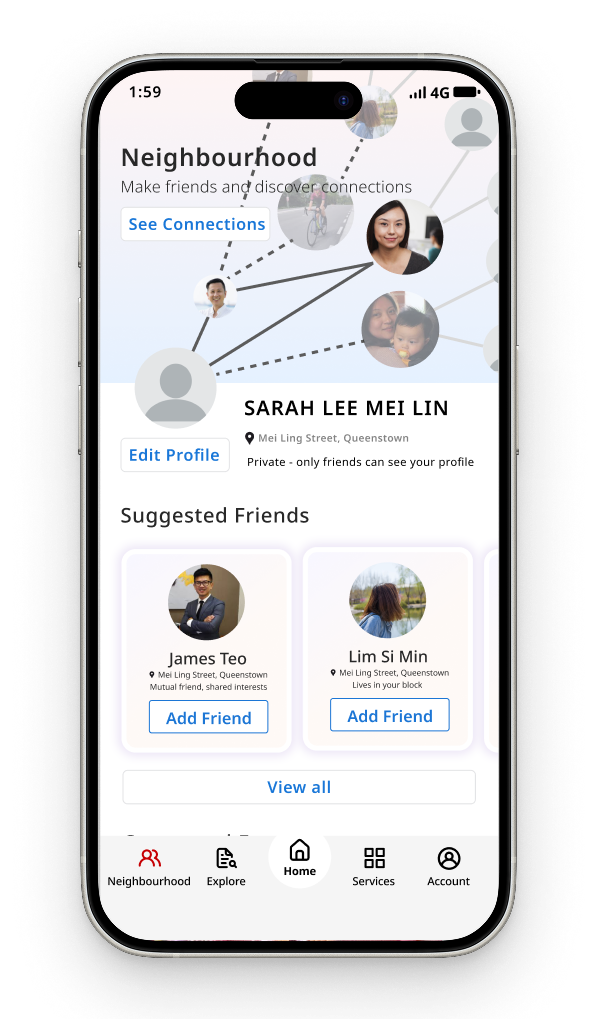
A community product that connects people in Singapore with their neighbours through shared interests. The design focused on three core principles that made connection feel effortless and low-stakes.
People connect to people, not places
By suggesting nearby neighbours with shared interests or mutual contacts, and recommending relevant local events, the product lowers the social barrier to initiating connections with strangers.
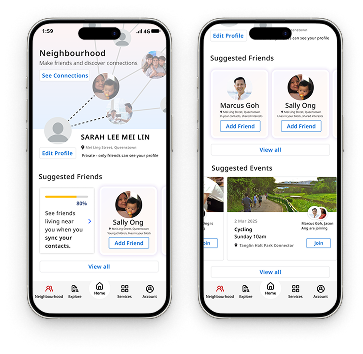
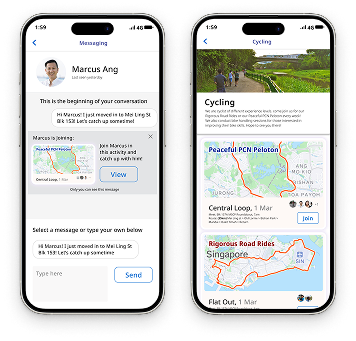
Instead of "friend me", start with small, manageable actions
Instead of framing connection as “making friends,” the product breaks interaction into simple, manageable actions, such as starting conversations around common interests or joining events with familiar faces.
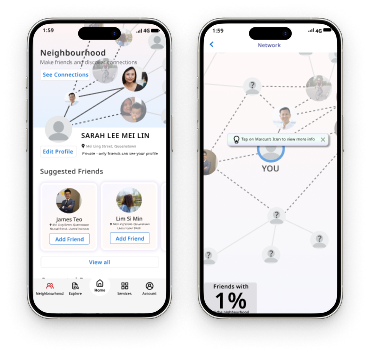
After meeting, we suggest people to connect
After events, we suggest people users they’ve already met and visually show how adding them expands their neighbourhood network—encouraging continued, effortless connection.
Vague problem to meaningful product
This project demonstrated how a broad and ambiguous goal—“improve neighbourliness”—can be transformed into a product through research and problem framing. By uncovering the real barriers to neighbourly interaction and reframing connection around familiarity, effort, and shared interests, we moved towards concrete design decisions.
The resulting product doesn’t try to force community, but instead creates the conditions for meaningful, low-friction connections. This demonstrates how clarity in problem definition is often the most impactful design outcome.
“Connecting with neighbours feels like a game, with secret characters to uncover."
- User, 39Solve a vague problem
The most important skill in this project wasn't finding a solution — it was reframing the problem. The initial brief was so open it was almost impossible to act on. Using design to scope it down to a specific, solvable question unlocked everything else.